Yes and No Shares: Two Sides of One Price
Yes and No are not two markets. They are two halves of one contract whose prices must sum to a dollar, and that identity explains a surprising amount.
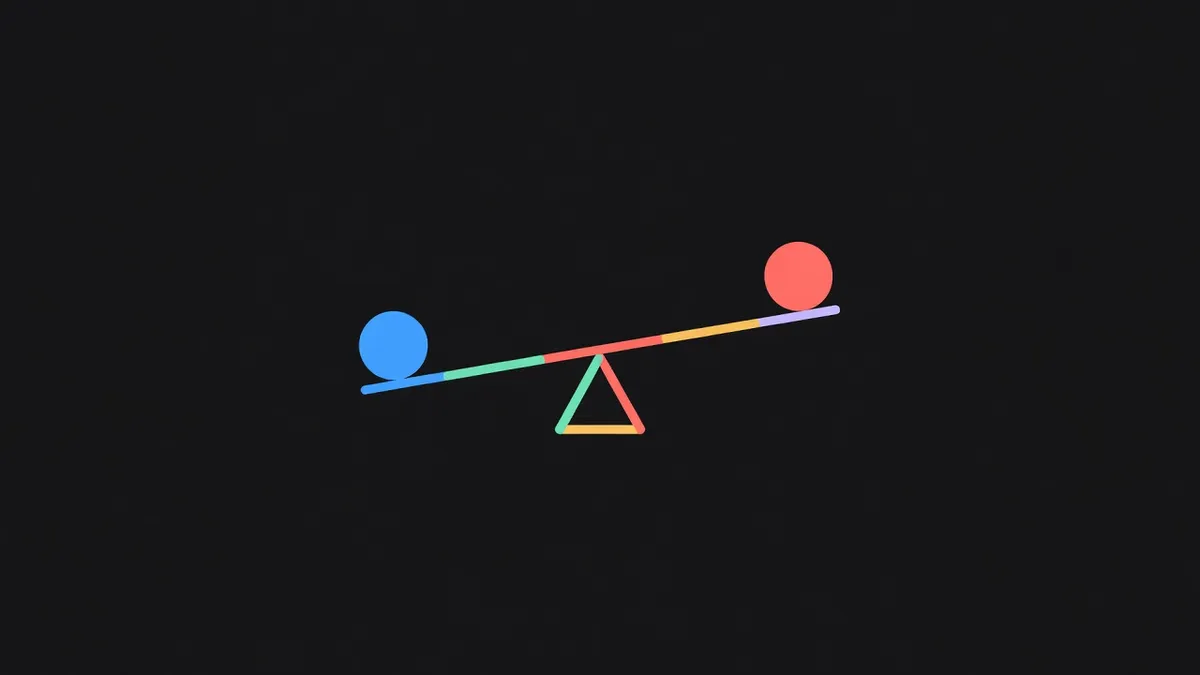
New readers often look at a market page and see two prices, Yes at 64 and No at 36, and assume they are looking at two things they could pick between. They are looking at one thing from two directions. Understanding that properly removes a whole category of confusion.
The identity
For a market with two outcomes, one of them must happen. So a portfolio holding one Yes and one No is guaranteed to pay exactly one dollar, whatever occurs. A guaranteed dollar cannot cost more than a dollar for long, and it will not cost much less either, because buying the pair below a dollar would be a free claim on the difference.
Therefore:
price(Yes) + price(No) ≈ $1.00
The approximation covers the spread and the fees. On a liquid market the pair will trade for very slightly more than a dollar if you cross both spreads, which is exactly the venue's cut for arranging it.
What this lets you do
Check whether a quote is live. If Yes shows 64 and No shows 30, the pair costs 94 cents and something is wrong — usually one side is stale, or you are looking at a last-traded price on one side and a resting offer on the other. Mid price, last trade and which one is the market is the guide for that distinction.
Convert any position into the other language. Selling Yes at 64 and buying No at 36 are the same trade. If one is easier to execute, or if only one side has depth, take the easier one. Your resulting exposure is identical.
Reason about direction without confusing yourself. People tie themselves in knots over whether they are short or long. You are never short in the borrowing sense here. You either hold Yes, or you hold No, or you hold nothing. Every position is a long position in one of the two outcomes.
Multi-outcome markets break the simple version
Plenty of markets have more than two outcomes: which of eight candidates wins, which of five ranges the inflation print lands in. The identity still holds, but across the whole set rather than a pair. All the mutually exclusive outcomes together must sum to a dollar.
In practice they rarely sum to exactly a dollar on screen, and the gap tells you something. If the outcomes sum to $1.06, the market is charging you a premium to cover every case — which is normal, because you would have to cross eight spreads to buy the full set. If they sum to 96 cents, either one leg is stale or the outcome set is not as exhaustive as it looks. When the outcomes do not add to 100% goes through both cases.

Why venues quote both sides
It would be enough to quote Yes and let people sell it. Venues quote both because it is easier to reason about buying something than about selling something you do not own, and because the order books on the two sides are not always equally deep. A market can have thin Yes offers and plenty of No offers at the mirrored price, and a reader who only looks at one side will conclude, wrongly, that there is nothing there.
When you are assessing whether a market can absorb your size, look at both books. Depth and slippage explains how to read what you find.
A worked example of the pair
Say a market on a scheduled economic release shows Yes at 71 and No at 30, and you can buy either.
Buying one of each costs $1.01. At settlement you receive $1.00 regardless. You have paid one cent for the privilege, which is the spread. That penny is the honest measure of what it costs to trade this market at this moment, and it is a much better measure than any advertised fee schedule, because it includes everything.
Now imagine the same market shows Yes at 71 and No at 27. The pair costs 98 cents and returns a dollar. That two-cent difference is what this site calls a theoretical cross-market edge when it appears between venues — theoretical because the moment you try to take it, you discover whether the quotes were real, whether both sides have depth, and what the fees and settlement timing do to it.
The habit worth building
Every time you look at a market, add the two prices in your head. It takes a second and it tells you three things at once: whether the quotes are current, roughly what the round-trip cost is, and whether the market is liquid enough to bother with. A pair that sums to $1.01 is a functioning market. A pair that sums to $1.09 is one where the spread will eat most of whatever you think you have found.
Next
How to read a prediction market page puts the pair alongside everything else on screen — volume, open interest, the book, the history — and says which parts are worth your attention.
Educational content only. Nothing here is financial advice, a solicitation, or an offer to trade. Prediction markets can move against you and a position can lose its entire value. Where this guide describes a difference between venues it describes a theoretical cross-market edge in observed prices, which is not a profit: fees, spreads, capital lockup, transfer time and differing settlement rules all come out of it first.
Keep reading
 Prediction Market Basics · 4 min readHow an Event Contract Pays OutAn event contract settles at one dollar or nothing. Understanding that single fact explains pricing, profit, loss and most of the mistakes people make early on.
 Prediction Market Basics · 4 min readPrediction Markets vs Polls: What Each One MeasuresPolls measure stated intention in a sample. Markets measure what people will risk money on. They answer different questions, and each fails in its own way.
 Prediction Market Basics · 4 min readWhat Is a Prediction Market? A Plain ExplanationA prediction market turns a question about the future into a tradable contract, and its price into a probability. Here is how that works, in plain language.
 Cross-Market Gaps · 3 min readTen Ways Cross-Market Analysis Goes WrongThe recurring errors in comparing prediction market prices across venues, from stale quotes to mismatched thresholds, and how to catch each one.