How an Event Contract Pays Out
An event contract settles at one dollar or nothing. Understanding that single fact explains pricing, profit, loss and most of the mistakes people make early on.
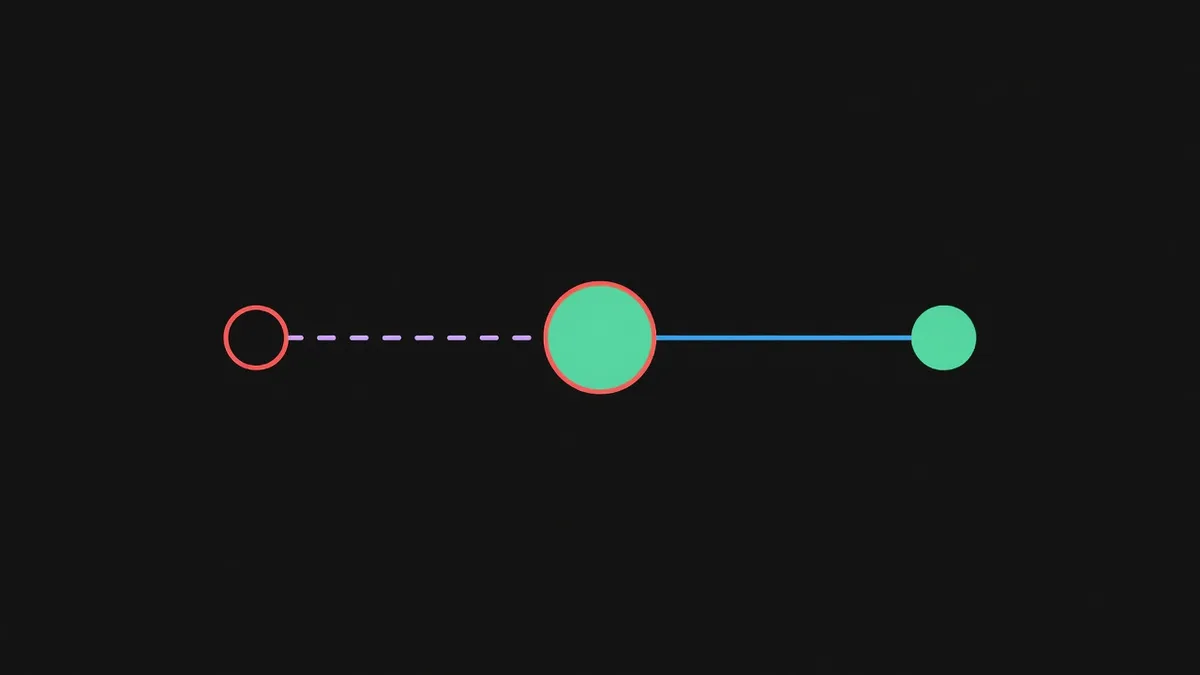
Every event contract you will meet on Kalshi or Polymarket does the same thing at the end of its life: it becomes worth exactly one dollar, or exactly nothing. There is no partial credit, no proportional payout, no consolation. This binary ending is what makes the arithmetic so clean, and it is also what trips people up.
The payout, and what it implies about price
If a contract pays a dollar when the answer is yes, then any price between zero and a dollar is a statement about how likely yes is. At 25 cents you risk 25 to win 75. At 90 cents you risk 90 to win 10.
Notice how differently those two feel even though both can be perfectly good trades. The 25 cent contract loses three times out of four if the market is correctly priced, and the 90 cent one loses one time in ten but loses nine times as much when it does. Neither is safer than the other in any meaningful sense. Both have the same expected value if the price is right, which is zero after you subtract costs.
Yes and No are the same contract
On most venues you can buy the No side directly. Buying No at 38 cents is economically the same as selling Yes at 62 cents — you receive a dollar if the event does not happen. The two prices must add to a dollar, because between them they cover every outcome.
That identity is useful. It means you never need to wonder whether to buy No or sell Yes: they are the same position described two ways, and the venue will normally quote you whichever is cheaper to execute. It also gives you a quick sanity check. If Yes is 62 and No is 40, something is stale, because 62 plus 40 is 102 and the pair should cost about a dollar. Prices near the extremes are where this arithmetic gets interesting.
What "settles" actually means
Settlement is the moment the contract stops being a claim and becomes money. Three things happen in sequence, and each one matters.
First, the event occurs, or the deadline passes. Second, the resolution source publishes whatever determines the answer — an official statistic, a certified result, a scheduled announcement. Third, the venue applies its written rule to that source and credits accounts.
Those steps are not instant. A market can be obviously decided in the world and still be trading at 97 cents rather than a dollar, because settlement has not run yet and your money is not free until it does. That gap is a real cost, and the guide on capital lockup works through what it is worth.

Profit and loss, worked through
Suppose you buy 100 Yes contracts at 40 cents each. You have paid $40. There are exactly two endings.
If the answer is yes, you receive $100. Your profit is $60 before fees, a 150% return on what you risked.
If the answer is no, you receive nothing. Your loss is the entire $40.
You can also exit before settlement by selling to someone else at whatever the market is then paying. If the price has moved to 55 cents you can sell your 100 contracts for $55 and take $15 of profit without waiting for the outcome. This is the normal way most positions end, and it is why the difference between selling early and holding is worth thinking about in advance rather than in the moment.
The maximum loss is knowable, which is unusual
One genuinely useful property of these contracts is that your downside is fixed at the price you paid. Buy at 40 cents and the worst case is losing 40 cents per contract. There is no margin call, no liquidation cascade, no way to owe more than you put in, because both sides were fully funded at the start.
This is not the same as saying the risk is small. Losing everything you committed is a complete loss, and it happens routinely — that is what a 40% probability means. But it is bounded and countable in advance, which makes position sizing a genuinely solvable problem rather than a guess.
Where it goes wrong
Three failure modes account for most bad outcomes, and none of them is about forecasting.
Misreading the resolution rule. The market resolved the way the rule said, not the way the headline said. This is the big one.
Forgetting the fees. A contract bought at 40 and sold at 44 looks like a 10% gain, and on some venues and sizes the fees will take a noticeable bite out of it. Run the numbers on the real cost of a round trip before you decide something is profitable.
Assuming a near-certain price is free money. Buying at 97 cents to make 3 cents means risking 97 to win 3. You need to be right about thirty-three times out of thirty-four just to break even. Those trades exist and can make sense, but they are not the low-risk corner they appear to be.
Next
Once the payout structure is clear, the natural next step is learning to read the price itself. Turning a price in cents into a probability covers the conversion and the traps around it.
Educational content only. Nothing here is financial advice, a solicitation, or an offer to trade. Prediction markets can move against you and a position can lose its entire value. Where this guide describes a difference between venues it describes a theoretical cross-market edge in observed prices, which is not a profit: fees, spreads, capital lockup, transfer time and differing settlement rules all come out of it first.
Keep reading
 Prediction Market Basics · 4 min readWhat Is a Prediction Market? A Plain ExplanationA prediction market turns a question about the future into a tradable contract, and its price into a probability. Here is how that works, in plain language.
 Prediction Market Basics · 4 min readYes and No Shares: Two Sides of One PriceYes and No are not two markets. They are two halves of one contract whose prices must sum to a dollar, and that identity explains a surprising amount.
 Prediction Market Basics · 4 min readPrediction Markets vs Polls: What Each One MeasuresPolls measure stated intention in a sample. Markets measure what people will risk money on. They answer different questions, and each fails in its own way.
 Data and Automation · 3 min readRate Limits, Polling, and Not Being a NuisanceA polling schedule that matches where the information actually is will use a fraction of the requests and produce better data than polling everything.