The Life of a Polymarket Market
Listing, trading, close, proposal, challenge, redemption. Each stage changes what the price means and how long your capital stays committed.
The moment an event happens is not the moment you get paid. On an on-chain venue there are several stages between the two, and each one costs time.
Listing
A market is created with a question, resolution criteria and a close time. The criteria are the contract — the title is a summary. For anything you would be annoyed to lose on a technicality, read the criteria before the title.
New markets are thin. Wide spreads, small size, a price that is one or two opinions rather than an aggregate. Reading a fresh listing as "the market's view" overstates what it is. When a price move means something.
Trading
The long middle. Liquidity builds on markets people care about and never arrives on the rest. The distribution is extremely uneven: a small number of markets carry most of the volume, and the tail is close to dormant.
For comparison work this matters enormously. A price on a dormant market is not a forecast; it is a leftover. Filtering by liquidity before comparing anything is not optional. Gap size versus liquidity is about the inverse relationship you will find, and why the biggest gaps are almost always the least real.
Close
Trading stops at the stated time. Your position is now fixed and cannot be exited, whatever happens next. This is the moment the decision between exiting early and holding becomes irreversible. Early exit versus holding.
Proposal
After the event, an answer is proposed on-chain, backed by a bond. This can be quick or slow depending on how quickly the underlying fact becomes verifiable.
Challenge window
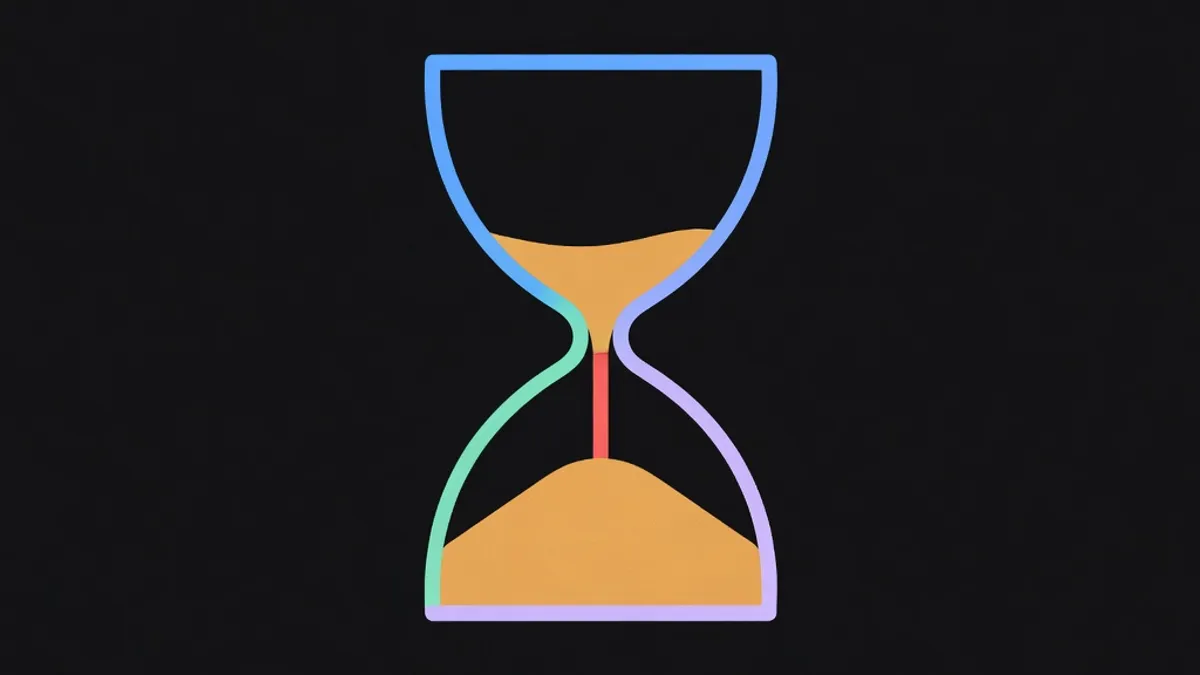
A fixed period in which the proposal can be disputed. For the overwhelming majority of markets nothing happens and the window simply elapses.
If the proposal is wrong, this window is the only opportunity to fix it. That is worth knowing if you hold a position on something contentious. How resolution works.
Dispute, if any
An escalated question goes to a vote, which takes additional days. Rare, but when it happens your capital is committed for the whole of it and the outcome is genuinely uncertain. Disputes.
Redemption
Winning positions are redeemed for collateral. This is a transaction you initiate. Positions do not always sweep themselves into your balance — check for unredeemed winnings, because forgotten ones sit there indefinitely.
What the timeline costs you
Add it up for a typical market: the event happens, a proposal appears within hours or days, a challenge window elapses, and redemption is available. Days, usually. For anything contested, longer.
That is dead time on your capital, on top of the whole life of the contract. When you compute the return on a position, the denominator is the full period from entry to redemption, not from entry to the event. Strategies that look fine on an annualised basis often stop looking fine once the settlement tail is included. Capital lockup.
Next
Educational content only. Nothing here is financial advice, a solicitation, or an offer to trade. Prediction markets can move against you and a position can lose its entire value. Where this guide describes a difference between venues it describes a theoretical cross-market edge in observed prices, which is not a profit: fees, spreads, capital lockup, transfer time and differing settlement rules all come out of it first.
Keep reading
 Polymarket · 3 min readFees, Gas and the Real Cost of Trading On-ChainTrading fees are only part of it. Network costs, bridging, spreads and capital lockup all take a share, and some of them are easy to miss entirely.
 Polymarket · 3 min readWorking With Polymarket's Public Market DataWhat public endpoints expose about markets, books and history, plus the on-chain data underneath, and how to use both without fooling yourself.
 Polymarket · 3 min readHow Polymarket's Order Book Actually WorksMatching happens off-chain and settlement happens on-chain. What that hybrid means for spreads, fills, latency and the data you can read from outside.
 Kalshi · 3 min readWorking With Kalshi's Public Market DataWhat the public endpoints expose, what they do not, and how to build something on top of them without hammering the service or fooling yourself.