Why the Biggest Gaps Are Always the Least Liquid
Plot price difference against traded size and the shape is always the same. Understanding why explains most of what a cross-market table is showing you.
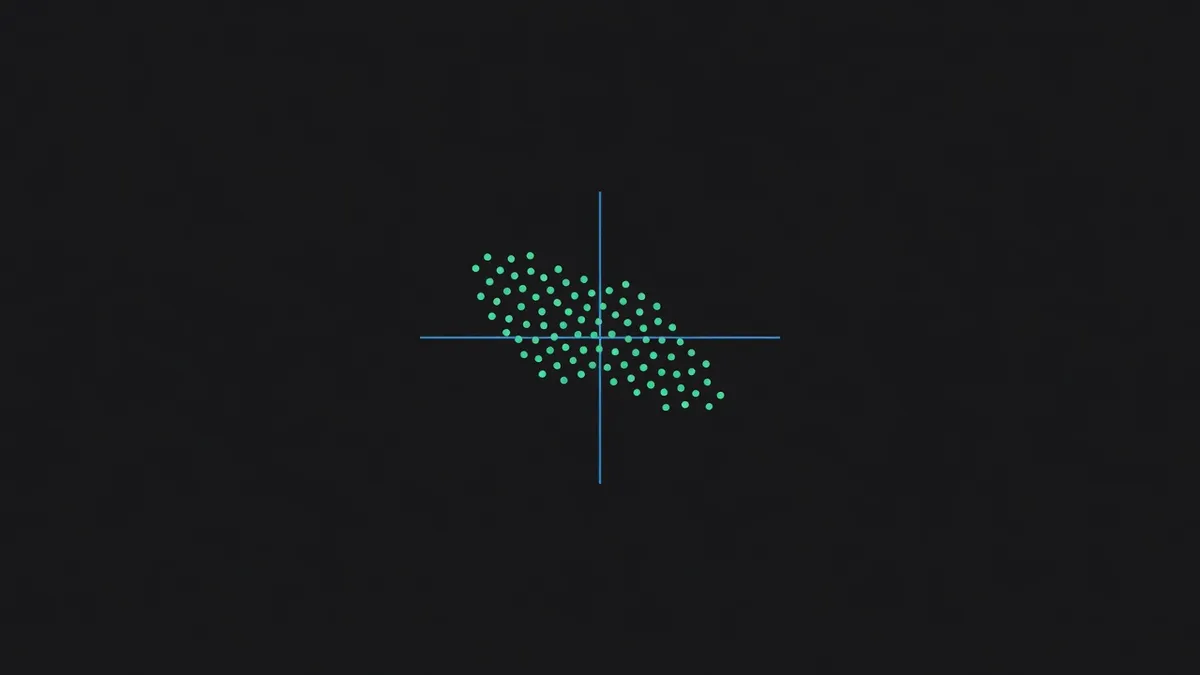
Take every matched pair across two venues, plot the price difference on one axis and the traded size on the other, and you get the same picture every time: a dense cloud of large gaps at low liquidity, thinning to a tight band of small gaps at high liquidity.
This is not a quirk of any particular dataset. It is the central fact about cross-venue price differences, and everything else follows from it.
Why it has to look like this
Liquidity is attention. A market with real size has people watching it. People watching it means any large deviation gets traded against quickly. The gap cannot stay large because someone is there to close it.
Illiquidity is absence. A market nobody trades has no mechanism pulling its price anywhere. It can sit ten cents away from a reasonable value indefinitely because nothing is pushing back.
Small gaps do not pay for attention. Closing a two-cent gap on a thin market is worth a few dollars. Nobody builds a process for that, so nobody does, so it stays.
Size is self-reinforcing. Liquidity attracts liquidity. The busy markets get busier and better priced; the quiet ones stay quiet and stay mispriced, harmlessly.
What this means for anyone looking for opportunity
The uncomfortable conclusion: the gaps large enough to be worth the effort are on markets too small to act on, and the markets big enough to act on have gaps too small to be worth the effort.
That is not a complete description — the band is not perfectly tight, and moments after news the liquid markets do diverge briefly — but it is the right starting assumption, and it is why claims of easy cross-venue returns should be met with a question about size rather than about price.

The measurement trap
There is also a pure data-quality version of the same relationship. Illiquid markets have wide spreads, stale quotes and one-sided books, all of which inflate a measured gap without any real difference existing at all.
So the low-liquidity end of the plot is a mixture of genuine unpoliced mispricing and pure measurement noise, and separating them requires exactly the filters in how to read a gap table.
What to do with the relationship
Filter on liquidity before anything else. A minimum book size on both sides removes most of the noise before it reaches you.
Express gaps net of achievable size. A four-cent gap on twenty contracts is eighty cents. Saying so in the table converts an exciting number into an accurate one.
Watch the tight band, not the cloud. Deviations within the high-liquidity band are the only ones that are both real and reachable. They are small, and they are the honest opportunity set.
Use the cloud for something else. The thin end of the distribution is not useless — it is a good map of which markets nobody is watching, which is genuinely interesting information about where attention is and is not.
Why this site shows it this way
Liquidity filters run before the table is built, size is shown alongside every gap, and the headline number is called a theoretical cross-market edge.
Presenting the raw cloud sorted by size would produce a far more dramatic page and would be a misrepresentation of what the data contains. Cross-market gaps, top movers for what has actually changed, and the methodology for how it is computed.
Next
The forecasting category begins with base rates, the single most useful habit for reading any of these numbers.
Educational content only. Nothing here is financial advice, a solicitation, or an offer to trade. Prediction markets can move against you and a position can lose its entire value. Where this guide describes a difference between venues it describes a theoretical cross-market edge in observed prices, which is not a profit: fees, spreads, capital lockup, transfer time and differing settlement rules all come out of it first.
Keep reading
 Cross-Market Gaps · 3 min readHow to Read a Cross-Market Gap TableA gap table sorted by size is a list of artefacts. Here is the order to read one in, what each column means, and which rows to ignore first.
 Cross-Market Gaps · 3 min readMatching Markets Across Venues Without GuessingBefore you can compare two prices you must establish that the two contracts are about the same thing. Structural matching, and why title similarity fails.
 Cross-Market Gaps · 3 min readStale Quotes and Why Timing Ruins ComparisonsThe largest source of phantom cross-market opportunity is not disagreement. It is one price being older than the other. How to measure and exclude it.
 Risk and Costs · 3 min readResolution Risk, the One That Is Not in the PriceBeing right about the world and wrong about the contract is a real and recurring outcome. Where it comes from and which markets carry most of it.