How Kalshi Fees Work, and Where They Hurt Most
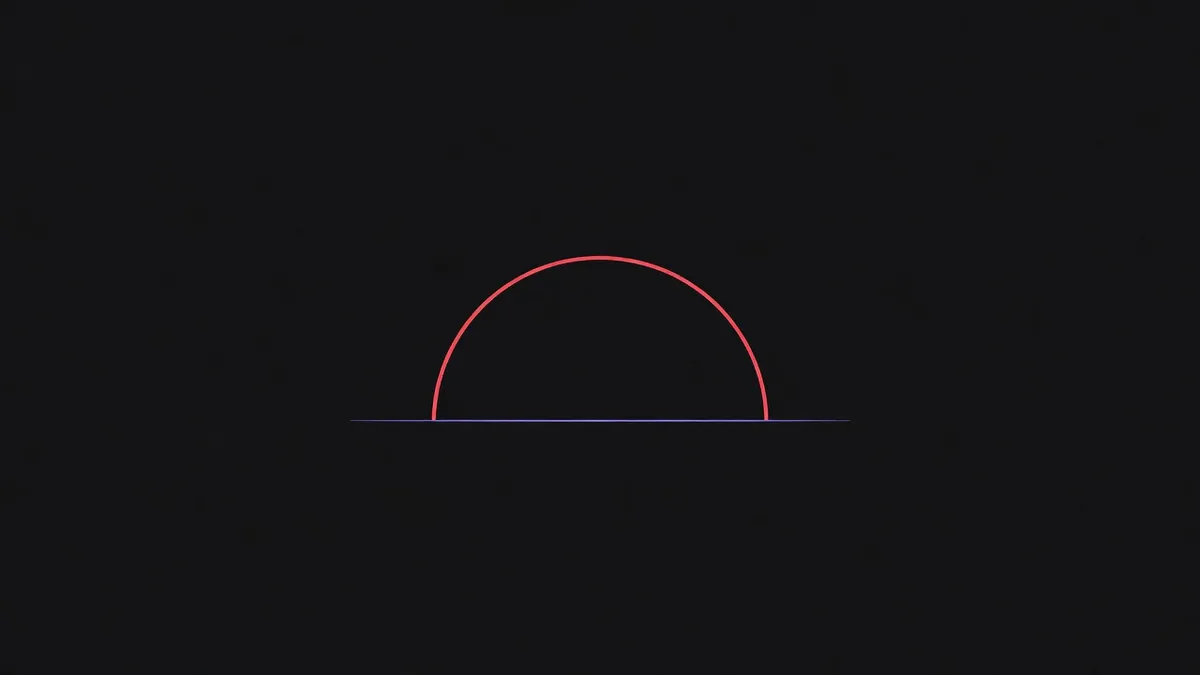
Kalshi's trading fee is not a flat percentage. It is shaped like a curve that peaks at fifty cents, and that shape changes which trades are worth doing.
Most venues charge a flat percentage and you can ignore it until you are sizing up. Kalshi's trading fee is shaped differently, and the shape has consequences that are worth understanding before you do any arithmetic about whether something is worth trading.
Fee schedules change. Treat the numbers you find here as a description of the shape, and read the current schedule on the exchange before relying on any specific figure.
The shape
The trading fee is proportional to price multiplied by one minus price. Written as a curve, it is an arch: near zero at one cent, near zero at ninety-nine cents, and at its maximum at fifty cents.
That is a deliberate design. The quantity price times one minus price is the variance of a binary outcome. A contract at 50 cents is maximally uncertain; a contract at 2 cents is nearly settled already. The fee scales with how much risk is actually being transferred.
What the shape does to your arithmetic
Coin-flip markets are the expensive ones. The market that feels most like a fair bet is the one where the fee takes the biggest bite. If you are trading around 50 cents, the round trip cost is at its structural maximum.
Tail trades are cheap in fee terms and expensive in other ways. A contract at 3 cents carries very little fee. It also carries the favourite-longshot bias, a one-cent tick that is a third of the price, and capital efficiency problems if you are on the sell side. Cheap fees do not make the tail an easy place to work.
Fees are charged per contract, and they round. Small orders can pay proportionally more than the formula suggests, because the rounding is not in your favour. Ten contracts is not one tenth of the fee of a hundred contracts.
Both sides of a round trip pay. If you intend to exit before settlement you pay twice. If you hold to settlement you pay once on entry. That difference alone can decide whether a strategy that exits early is better or worse than one that holds. Early exit versus holding to settlement works through the comparison.
Why this matters for cross-venue comparison
Here is the case that catches people. You see the same event priced at 61 on one venue and 55 on another. Six cents looks like a lot.
Now apply the costs. You cross a spread on each side. You pay the fee on the Kalshi leg, largest because both prices sit near the middle of the range. You lock capital on both sides until settlement. And the two questions are probably not perfectly identical, so part of the gap is compensation for a real difference rather than an error.
A six cent gap can be entirely consumed before anything goes wrong. This is why this site describes what it finds as a theoretical cross-market edge — the number the prices imply, before costs — and never as a profit. What a cross-market gap is actually worth does the subtraction line by line, and how fees eat an edge generalises it.
Maker and taker
Where a venue distinguishes between resting an order and crossing the spread, resting is generally cheaper. That is an argument for limit orders over market orders wherever you can tolerate the risk of not being filled. Limit orders versus market orders covers the trade-off honestly, including the cost of the fills you miss.
The practical rule
Before deciding a price difference is interesting, subtract: the fee on each leg, half the spread on each leg, and an allowance for the two contracts not meaning exactly the same thing. What is left is what you are actually looking at. It is usually a lot smaller than the headline.
Next
Where Kalshi settlement numbers come from is about the other half of the contract: who decides what happened.
Educational content only. Nothing here is financial advice, a solicitation, or an offer to trade. Prediction markets can move against you and a position can lose its entire value. Where this guide describes a difference between venues it describes a theoretical cross-market edge in observed prices, which is not a profit: fees, spreads, capital lockup, transfer time and differing settlement rules all come out of it first.
Keep reading
 Kalshi · 3 min readHow a Kalshi Contract Is Put TogetherSeries, event, strike and settlement rule. Taking apart a single Kalshi market so the ticker stops looking like noise and starts reading as a sentence.
 Kalshi · 3 min readWhere Kalshi Settlement Numbers Actually Come FromA contract is only as good as the source that settles it. What Kalshi names as its sources, how revisions are handled, and what happens when data goes missing.
 Kalshi · 3 min readWhat Kalshi Is, and What Makes It DifferentKalshi is a US federally regulated exchange for event contracts. Here is what that regulation actually changes about the product you trade on.
 What Markets Price · 3 min readInterest Rate Markets and Why They Are Well PricedRate decision contracts compete with an enormous existing futures market. That competition makes them among the most reliable prices on any event venue.